Observation before meaning
Every reading begins with the image: what is present, what is absent, what moves, what resists, and what repeats. Try it on one card with a free yes/no tarot reading.
 The Tarot CodexOfficial archive
The official archive of a ten-book tarot system
Learn to read the cards themselves—not memorize 78 fixed meanings. Ten focused volumes turn image, number, element, gesture, and pattern into one coherent reading method.
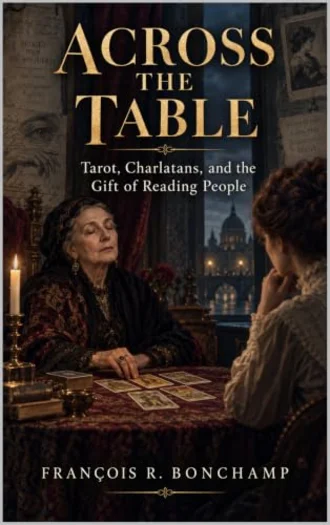
What happens when you look past the cardboard and study the person in the other chair?
Beyond the ten-volume Tarot Codex series, François R. Bonchamp’s new standalone book explores the 300-year history of card reading, the counterfeiters and cold reading swindles, and the hostage negotiator’s craft of baseline observation, attention, and tactical empathy.
The method
The Tarot Codex treats tarot as a language of visible evidence. It begins with the card as a scene, then studies number, suit, element, gesture, symbol, context, and relationship until interpretation becomes precise without becoming mechanical.
Every reading begins with the image: what is present, what is absent, what moves, what resists, and what repeats. Try it on one card with a free yes/no tarot reading.
The books give intuition a framework: numbers, elements, courts, spreads, correspondences, and reversals all become readable systems.
The site teaches enough to reveal the method. The complete depth remains inside the Codices themselves.
A method readers recognize
The Codex replaces disconnected definitions with a repeatable way to see how image, suit, element, number, posture, and context work together. Learn deeply without turning tarot into a memory test.
See independent customer feedback on AmazonThe complete collection
Begin with sight, follow the numbers, enter the elements, meet the court, study the symbols, read the stars, connect the cards, observe the body, uncover the Minor Arcana, and unlock reversals.
Study the reading path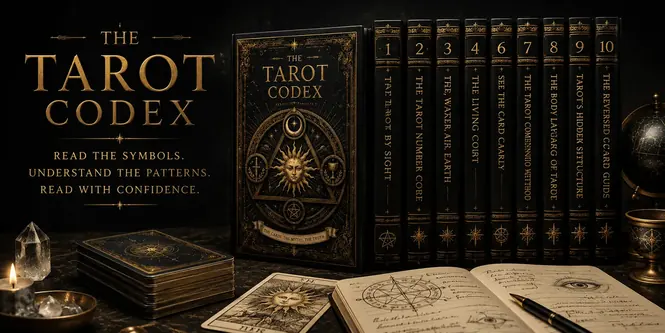
The Codices
Tarot Knowledge
the reading craft
A forensic study of the history of card reading, the mechanics of cold reading, and the psychological craft of observing the person sitting across the table.
symbolic analysis
Tarot becomes clearer when it is approached as a visual language of scene, symbol, number, element, gesture, and pattern.
tarot numerology
Aces through Tens are not decorations. They give the Minor Arcana a developmental grammar.
suits and elements
Fire, Water, Air, and Earth describe four fields of human experience inside the deck.
court cards
Court cards are not fixed personality labels. They can describe roles, behaviors, conflicts, and stages of growth.
reversed cards
A reversed card is not automatically the opposite. It shows a changed relationship to the upright theme.
Each book stands alone. Together, they form a structured path from first observation to confident interpretation.
Continue the Series